Before starting an interview, there are some practical, must-do preparations. The items on this list might appear obvious, but I recommend using it and ticking off each item as you prepare for an interview.
Get a glass of water. Stretch. Get comfortable.
Turn ringer off all phones in the vicinity of the interview.
Turn off browsers, email, and other distractions.
Clear workspace of unnecessary debris, so you have space.
Have a page ready and open to start typing if you wish to take notes during the interview.
Have note paper and pens available (low-tech can be helpful).
Turn on your spare computer. You may even wish to navigate to the communications software you are using (Elluminate, Adobe Connect, or other software).
Use two recording devices, if possible. I am using Adobe Connect, but I also use a LiveScribe pen as a secondary device. Make sure all your software is up-to-date. You don’t want updates going on during or after your interview (potentially causing you to lose data).
Test your computers and your recording devices. (You may even wish to do some tests the night before with a friend or family member.)
Print your interview schedule, so you can jot quick notes on it as the interview proceeds. Use the interview schedule wisely. Your methodology and goals should dictate the extent to which it structures your interview.
Relax and think about your approach before you start. Review any information that you might have about your participant(s). Review your goals.
Additional suggestions or advice for ensuring smooth-running interviews is welcome.
I am finally ready to start recruiting participants for my doctoral thesis on Identity Positioning of Doctoral Students in Networked Learning Environments. The seemingly endless wait for ethics permission and institutional permission (sometimes known as site permission) was actually a very useful time. I used the time for further reading and reflection on phenomenography in light of the recent methodology workshops and my readings on methods.
Marton, F., & Booth, S. (1997). Learning and awareness. Mahwah, NJ: Lawrence Erlbaum Associates.
.
Why study interviewing methods so intensively right now?
I feel strongly that one must understand one’s methodology before collecting data. And, it is important to be mindful of all the choices that one must make while employing data collection methods. Some researchers utilize data collected previously by other researchers for other research purposes. This might be suitable avenue for researchers who have difficulty accessing some participants or whose projects are on tight time constraints. It might also be done simply for convenience. In some cases, seemingly perfect data sets can be procured from national databases such as the UK Data Archive. As I read more deeply about phenomenography, I sense that it is in the best interests of my own study to collect data carefully with sensitivity to phenomenographic theory and procedures of analysis. This is also the position taken by Bowden (2000):
Whatever research method is used, researchers need to articulate the purposes of their project and to keep those purposes in mind at all stages of the research—in the design of the investigation, in the development of the data collection processes, in the collection of data and in the analysis and interpretation. (p. 7)
What is a phenomenographic interview?
Interviewing is the most common method for collecting data in phenomenography (Walsh, 2000, p. 19, Marton, 1986, p. 42). Trigwell (2000) and Dunkin (2000) suggest that the ideal number of interviews rests around 15 to 20. In phenomenological studies, the number of suggested interviews might be less as phenomenology seeks to explore the essence of an individual’s experience in some depth. Phenomenography, on the other hand, focuses on the limited possible ways of experiencing a given phenomenon across a group of individuals. The outcome space (results) is a compilation of categories of description which expresses the variation. As such, it is necessary to reach a balance between depth of description and breadth of experience among a group of individuals.
Interviews are typically semi-structured (or “guided” if you choose Olson’s terminology) and last roughly 40 to 60 minutes or until the “the interviewer feels the experience has been described, and the meaning of relevant words has been revealed (Trigwell, 2000, p. 67). Most phenomenographers seem to agree that the participants should have sufficient flexibility to describe the experiences as they wish in their own way. Hence, most questioning and probing is open-ended. Bowden (Chapter 1) and Prosser (Chapter 3), in working with children, prefer to offer “problem questions” that the participants are asked to resolve. By asking participants to work through problems or tasks “interviewees are encouraged to reveal, through discussion, their ways of understanding a phenomenon, that is, to disclose their relationship to the phenomenon under consideration” (p. 9). Most of the questions in a phenomenographic interview follow from comments of the participant (Trigwell, 2000). Some sample questions that Bowden supplies (p. 10):
Could you explain further?
What do you mean by that?
Is there anything else you would like to say about this problem?
Prosser offers some interesting observations on eliciting information from the participants:
While it is relatively easy to get interviewees to describe their strategies, it is much more difficult to get them to discuss their intentions underlying their strategies and their conceptions of phenomena. (Prosser, 2000, p. 44).
To approach the participant’s conceptions, the researcher must consider the interview/discussion as a whole. According to Marton & Booth (1997) interviews take place on two levels: the interpersonal contact between the interviewer and the participant and at a metacognitive level in which the participant relates his/her awareness of an experience (Marton & Booth, 1997, p. 87). So, whilst the researcher attempts to maintain focus on the target conception(s), he/she must also provide room for the participant fully express related nuances and details. In some cases, it might be helpful within the context of the co-constructed interaction (see previous blog postings on interviews), for the researcher to share her own experiences. However, Bowden (Chapter 4) warns against “leading too much” to avoid influencing the participants. As per my previous blog postings on interviewing, anything that the researcher discloses during the interview should be as carefully transcribed and reported as the participant’s dialogue.
In some cases, a phenomenographic interview might seem to revolve tediously around the same question over and over again. This is partially true. A phenomenographic interviewer will ask similar questions in different ways so as to elicit a number of different views on the phenomenon. “Typically, a range of questions is used to provide views of each conception from several angles in order to make the description of the conception as rich as possible” (Dall’Alba, 2000, p. 94).
In a metaphorical sense the group of readers can be thought of as a prism through which the text passed, to be refracted and to exit in distinctly different meanings (Marton & Booth, 1997, p. 150).
Definitions
The following definitions are in no particular order except that I hope that one flows to the next. Also, they contain direct quotes from the books below with more specific referencing at the bottom of this page.
Marton, F., & Booth, S. (1997). Learning and awareness. Mahwah, NJ: Lawrence Erlbaum Associates.
Phenomenography
Not a method, but an approach primarily used in educational research (Marton & Booth, 1997, p. 110).
Takes a “relational or constitutionalist view” (Trigwell, 2000, p. 63). [See “conceptions” below.]
The classic (and most cited) definition of phenomenography comes from Ference Marton himself:Phenomenography is a research method adapted for mapping the qualitatively different ways in which people experience, conceptualise, perceive, and understand various aspects of, and phenomena in, the world around them. (Marton, 1986, p. 31 also cited in Bowden, 2000, p. 2)
Bowden describes the nature of phenomenography:. . . in a sense, phenomenographic research mirrors what good teachers do. It tries to understand what the students are doing in their learning. It attempts to discover what different approaches students are taking and to understand these in terms of the outcomes of their learning activities. (Bowden, 1986, p. 10 cited in Bowden, 2000, p. 48)
Unit of study: “a way of experiencing something” (Marton & Booth, 1997, p. 111). Also: a way of discerning something (Marton & Booth, 1997, p. 112).
Object of research: “the variation in ways of experiencing a phenomenon” (Marton & Booth, 1997, p. 111).
“The aim is . . . not to find the singular essences [as in phenomenology], but the variation and the architecture of this variation in terms of the different aspects that define the phenomena” (Marton & Booth, 1997, p. 117).
Learning
Within the phenomenographic perspective, learning involves a change in perception or integration of concepts. Marton & Booth (1997) write:. . . learning proceeds , as a rule, from an undifferentiated and poorly integrated understanding of the whole to an increased differentiation and integration of the whole and its parts. Thus, learning does not proceed as much from parts to wholes as from wholes to parts and from wholes to wholes. (p. viii).
“Learning is mostly a matter of reconstituting an already constituted world” (Marton & Booth, 1997, p. 139).
According to Marton & Booth (1997), experiencing learning involves the how and the what. How refers to the “indirect object and the act of learning whilst the what refers to the direct object of learning (p. 91). The how and the what both contain structural (with internal and external horizons) and referential aspects. [See definition of experience below.] ” [Note: Should one use indirect object in this instance or ablative / adverbial? This would be so if the “how” phrase were somehow a predicate. But, “how” refers to an act. The word, act, is a noun form. But, in that case, can it not also be a kind of direct object? How refers to manner, which would be expressed in the ablative case in Latin. Hmmmm . . . ]
Conceptions
An individual’s personal understanding of a phenomenon. This is not directly accessible or knowable by the researcher.
The “relation between the individuals and the phenomenon” (Bowden, 2000, p. 17, 50). [This suggests the relational/constitutionalist view mentioned above.]
Synonyms: ways of understanding, ways of comprehending, conceptualizations, ways of experiencing (Marton & Booth, 1997, p. 114).
Sometimes referred to as “apperceptions”.
Apperception
“‘Appresentation’ refers to the fact that although phenomena are, as a rule, only partially exposed to us, we do not experience the parts as themselves, but we experience the wholes of which the parts are parts. We do not experience silhouettes but phenomena (material or conceptual) in all their complexity of space and time” (Marton & Booth, 1997, p. 100).
Description
“The description we reach is a description of variation, a description on the collective level, and in that sense individual voices are not heard. Moreover, it is a stripped description in which the structure and essential meaning of the differing ways of experiencing the phenomenon are retained, while the specific flavors, the scents, and the colors of the worlds of the individuals have been abandoned” (Marton & Booth, 1997, p. 114). [Somewhat reductionist.]
“The descriptions arising from phenomenographic research are relational, experiential, content-oriented and qualitative” (Marton, 1988, p. 94 cited in Dall’Alba, 2000, p. 94).
Category of description (CoD)
Sometimes confused with conception. However, a CoD is a construct created by the researcher to represent as closely as possible the participants’ conceptions—at the collective level (Marton & Booth, 1997, p. 128).
Some researchers feel that CoDs emerge from the data as with grounded theory. In this view, the CoDs are viewed as forming an essential part of the data. I believe this suggests that the CoDs are believed to exist a priori. This sits in opposition to a social constructionist perspective in which the interaction of the researcher and the data mutually bring each other into existence (Walsh, 2000).
Others, such as social constructionists, feel that CoDs are constructed and as such reflect the “relationship between the data and the researcher” (Walsh, 2000, p. 20). Rather, in my view, CoDs reflect a relationship between the researcher and the understanding shared by the participant. This view recognizes the role of the “wider analytical process” which rests upon a holistic-phenomenographic approach from project initiation.
Outcome space
The outcome space represents the set of categories of description and outlines how they are logically related to each other. Equally important, the outcome space also indicates the internal consistency of the categories themselves (Walsh, 2000, p. 26). During analysis, constant examination of the internal and external logic guides the iterative construction of the CoDs and, hence, the outcome space.
“. . . the outcome space is the complex of categories of description comprising distinct groupings of aspects of the phenomenon and the relationships between them” (Marton & Booth, 1997, p. 125).
“A more reasonable idea is to see the object as a complex of the different ways in which it can be experienced . . . ‘Outcome space’ thus turns out to be a synonym for ‘phenomenon’: the thing as it appears to us, which contrasts with the Kantian ‘noumenon’: ‘the thing as such’” (Marton, 2000, p. 105).
The outcome space often results in 2 to 9 conceptions described or displayed in a way that shows how they relate to one another (Trigwell, 2000). [Interesting: this is reminiscent of Miller’s Law, the Magical Number Seven Plus or Minus Two: Some Limist on our Capacity for Processing Information.] Trigwell (2000) adds that the small number of conceptions might be due to the relative homogeneity of the participants within a given study.
Experience
“Experiences are reflected in statements about the world, in acts carried out, in artifacts produced” (Marton & Booth, 1997, p. 120). Phenomenographers take a “second-order perspective” that allows them to examine these experiences as they express their experiences. (p. 120). The researcher brackets as much as possible his/her own experiences of the phenomenon.
Experiences are neither mental nor physical, but arise as a relationship between the two. In other words, experience is non-dualistic (Marton & Booth, 1997, p. 122 and p. 164; Marton, 2000).
According to Marton & Booth (1997), all experience is composed of structural and referential aspects. Structural aspects are composed of internal and external horizons which are internally related:
Structural aspect (how)
How the explanation is given (Trigwell, 2000).
Indirect object.
“The structural aspect of a way of experiencing something is thus twofold: discernment of the whole from the context on the one hand and discernment of the parts and their relationships within the whole on the other” (Marton & Booth, 1997, p. 87).
Internal horizon of the structural aspect: “The parts and their relationships, together with the contours of the phenomenon” experienced (Marton & Booth, 1997, p. 87).
External horizon (context) of the structural aspect: “That which surrounds the phenomenon experienced, including its contours” (Marton & Booth, 1997, p. 87).
Referential aspect (what)
Meaning
What is focused on; the content (Trigwell, 2000).
Direct object.
Also has a structural and referential aspect with internal and external horizons. (Yes, this is a bit confusing; Marton & Booth’s (1997) diagrams help greatly).
Trigwell (2000) elaborates:Two internally related aspects of a category. If you like, an action (how) and the something being acted upon (what). For example, transmission is the how and the content is the what. We actually saw the how and the what as the same as the structural and the referential. (p. 74)
Figure & Field / Focal & Figural
“The dimensions are discerned in relation to the thematic field against the background of which the phenomenon, and the situation in which it is embedded, is seen” (Marton & Booth, 1997, p. 100). Note: a situation is located within a specific time, context, and space. A phenomenon is “experienced as abstracted from or transcending such anchorage” (Marton & Booth, 1997, p. 82). This distinction is important in the study of learning as some learners may focus specifically on the situation whilst others may focus on the phenomenon underlying the situation. This is the foundation for the concepts of surface and deep learning.
“. . .figure and ground . . . The underlying idea is that the salient features of a phenomenon—what we focus on when we talk about it—constitute what is important about it for us in that particular context” (Patrick, 2000, p. 123).
Awareness
These concepts, focal and figural, are integral to the phenomenological concept of awareness:. . . awareness has two most important qualities. One of them is that we cannot be aware of everything in the same way. I few could, there would not be any differences between individuals as far as their experiences, and hence their acts, are concerned. There would in fact be no world experienced; nothing would be more important than anything else. The other is that we are aware of everything at the same time, albeit not in the same way. Awareness is layered. Some things make up the core; they are objects of focal awareness; they are figural. Other things belong to the field, or fields, surrounding the core. Yet others belong to the fringe that extends indefinitely. Although we are not consciously aware of most things, we are aware enough for them to be pulled into the core if the changing here and now were to make them relevant (Marton & Booth, 1997, p. 123).
“The totality of a person’s simultaneous experiences, her relatedness to the world, I will call her awareness. The term ‘awareness’ is used interchangeably with the term ‘consciousness’ (Marton, 2000, p. 109).
“Our awareness has structure to it. Certain things come to the fore, they are thematised . . . there are different degrees of how figural, thematised, and explicitly things or aspects are in our awareness” (Marton, 2000, p. 110).
Discernment
“We find that in various situations people manage to different degrees to discern and keep all relevant aspects of the phenomenon and of the situation in focal awareness simultaneously. What happens is that single aspects are abstracted or separated out, while others are left undiscerned” (Marton & Booth, 1997, p. 102).
“The variation between different ways of experiencing something, then, derives from the fact that different aspects or different parts of the whole may or may not be discerned and be objects of focal awareness simultaneously” (Marton & Booth, 1997, p. 112).
“It is necessary that something varies, some aspect of the situation that surrounds the person, for change to be experienced, in the least case something changing from one state to another. This change may happen to the learner or be brought about by her. It is through variation that aspects are differentiated within the experience of a phenomenon” (Marton & Booth, 1997, p. 145).
But, what has this to do with interviewing? That is the topic of my next blog posting.
References
Bowden, J. (2000). Chapter 1: The nature of phenomenographic research. In J. A. Bowden & E. Walsh (Eds.), Phenomenography (pp. 19-33). Melbourne, Australia: RMIT Publishing.
Bowden, J. (2000). Chapter 4: The experience of phenomenographic research. In J. A. Bowden & E. Walsh (Eds.), Phenomenography (pp. 19-33). Melbourne, Australia: RMIT Publishing.
Dall’Alba, G. (2000). Chapter 6: Reflections on some faces of phenomenography. In J. A. Bowden & E. Walsh (Eds.), Phenomenography (pp. 19-33). Melbourne, Australia: RMIT Publishing.
Marton, F. (1986). Phenomenography: A research approach to investigating different understandings of reality. Journal of Thought, 21(3), 28-49.
Marton, F. (2000). Chapter 7: The structure of awareness. In J. A. Bowden & E. Walsh (Eds.), Phenomenography (pp. 19-33). Melbourne, Australia: RMIT Publishing.
Marton, F., & Booth, S. (1997). Learning and awareness. Mahwah, NJ: Lawrence Erlbaum Associates.
Patrick, K. (2000). Chapter 8: Exploring conceptions: Phenomenography and the object of study. In J. A. Bowden & E. Walsh (Eds.), Phenomenography (pp. 19-33). Melbourne, Australia: RMIT Publishing.
Prosser, M. (2000). Chapter 3: Using phenomenographic research methodology in the context of research in teaching and learning. In J. A. Bowden & E. Walsh (Eds.), Phenomenography (pp. 19-33). Melbourne, Australia: RMIT Publishing.
Walsh, E. (2000). Chapter 2: Phenomenographic analysis of interview transcripts. In J. A. Bowden & E. Walsh (Eds.), Phenomenography (pp. 19-33). Melbourne, Australia: RMIT Publishing.
Trigwell, K. (2000). Chapter 5: A phenomenographic interview on phenomenography. In J. A. Bowden & E. Walsh (Eds.), Phenomenography (pp. 19-33). Melbourne, Australia: RMIT Publishing.
At first glance, this idea does not seem altogether that new. Yet, to my knowledge, no one other than Dr. David Morgan, a sociologist at Portland State University [oops! I thought he was from the U of A!] has conceptualized and named this form of interview format. Dr. Morgan acknowledged that other authors have mentioned “micro groups” and “mini-groups”, but there is not much in the literature. Please post a comment if you have seen any literature about this kind of interview.
To understand it, I will first outline the similarities and differences with regular one-person interviews and focus groups. This will be grossly simplified, but it allows a point of departure for an examination of TPIs.
One-person interviews
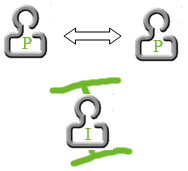
In a conventional one-to-one interview, the interviewer communicates with a participant.
Focus group
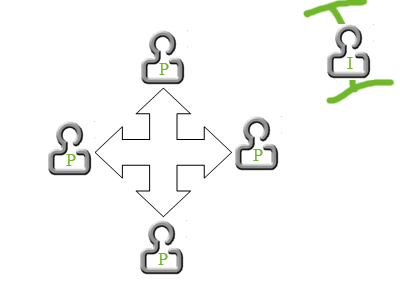
In a focus group, the interviewer facilitates a conversation. But, the participants then carry on, sometimes forgetting about the presence of the interviewer. Focus groups allow a researcher to accomplish at least two things: 1) ask questions, and 2) observe interactions among focus group members.
Two-person interviews (TPIs)
TPIs represent a hybrid of the focus group configuration. Naturally, the number of participants is more limited which reduces the logistics problems of gathering four to six people (or more) together for a meeting. TPIs also allow the interviewer to observe the interactions between the two participants. As such, one of the main goals is to encourage a conversation between the two participants.
According to his presentation, each time you add another person to the interview setting, you add additional complexity. In a dyadic situation, the participants exchange views bi-directionally. If a researcher adds an additional conversant (triad), there is a possibility for three separate conversations. The conversation can split.
Dr. Morgan illustrated how time is (possibly) shared within the three configurations above:
Interview time
Configuration
Time
Data
1 hour session
One-person
1 hour for the participant
Questions answered; one perspectiveObservation of individual only
1 hour session
TPI
30 minutes each
Questions answered; two possible perspectivesObservation of interaction
1 hour session
Focus group (6 people)
10 minutes each
Questions answered; six possible perspectivesObservation of interaction
Next, I will write about some of the interesting issues that Dr. Morgan mentioned including: heterogeneous groups, homogeneous groups, under- and over-disclosure, interview structure, relationships and rapport, and backchannels. And, I will discuss how this might help my phenomenographic study.
I finished this book yesterday at my favourite coffee shop. Lo and behold, I had neither computer nor paper to jot down my notes. So, I pulled out my HTC TYTN II and hand-wrote some notes [I have not yet succumbed to the i-Revolution of the evil geniuses at Apple]. I sometimes carry a little fold-out Bluetooth keyboard and type notes in mobile Word, but alas I was completely unprepared.
James and Busher’s (J&B’s) book did not treat interviews in the same ways as Olson and Fontanas & Prokos did. There were some similar themes regarding ethics and the balance of power between the interviewer and the participants. And, J&B discussed the importance of the researcher understanding his/her ontological and epistemological stance. But, the main focus of this book, in my opinion, on the nature of the online environment and how it affects the construction and understanding of discourse in online interviewing. As such, the book is ideal for those of us who are studying online identity formation and maintenance. Including this book amongst my readings of interview methods was a good way to round out my investigation.
The authors regularly use the word disembodied in referring to the human experience online. The word crept into much of their text in each chapter possibly indicating their own private orientation towards online interaction. For example, J&B write:
This chapter [four] therefore discusses how knowledge is constructed in a disembodied, anonymous and textual environment . . . (p. 43)
Further, the body itself is discussed:
The centrality of the body plays a critical part in developing and maintaining social encounters. It influences the ways in which researchers and participants construct their identities and those of the other (Giddens, 1991) and how they assert their agency to make sense of the ‘territory’ (social space) of the social interaction in the face-to-face encounter. (p. 32)
I do not disagree with the importance of the body as we are all physical beings “thrown” into a physical world. Interaction within the physical world shapes how we understand life. However, I grow concerned when social scientists suggest that the ways humans interact online is fundamentally different from how they interact in other environments. Interaction in any environment is mediated—in a face-to-face milieu, this might be through light and sound waves. Mediation will affect the cues people perceive and their sense of time and space (p. 10). Sense of time and space will alter how they interact: what people say, how they say it, and why they say it—when, where . . . The meanings of interaction will shift for the actors as they send and receive cues through different times and spaces. These factors are of much interest to qualitative researchers (p. 23).
So, normally, I would take the repetition of the word disembodiment as a warning sign. Gladly, I found that the authors also offer different perspectives of the online experience:
. . . if researchers are to understand life online, they have to understand that participants’ experiences are connected and shaped by cultural and social elements that are both real and virtual, public and private and online and offline. (p. 11)
Some online researchers have argued that to understand life online you need to understand the broader context because ‘being online and being offline are intersecting and interweaving experiences’ that are influenced and shaped by cultural and social elements (Rybas and Gajjala, 2007 cited in J&B, 2009, p. 34). Identity is fluid and potentially multiple on the Internet, but people similarly engage in these practices in other areas of their lives and did so prior to the existence of the Internet. In other words there is a ‘connected space’ in which individuals exist online and offline simultaneously (Kendall, 1999, p. 6 cited in J&B, 2009, p. 34).
Why is it important to avoid (or acknowledge) the online-interaction-is-disembodied-bandwagon? Because it has significant underlying implications for the way researchers and practitioners shape their online research and online learning environments. By recognizing that the humans-behind-the-screen are actual beings with continuous identities rooted in physical, cultural, and social environments, we can begin to understand why they might react to given situations the way they do. (Note: I do not suggest that we can ever fully understand the intentionality of others.) J&B warn researchers about the “false notion of sameness”, the idea that because people share time and space online they also share values and understanding (p. 47).
. . . participants are likely to assign different valences (strengths) of power to each other, possibly incorrectly. This is because the valence they assign will depend on the cultures from which they come, not the culture in which the others are located. (p. 45)
Further, (and I love the terminology):
“A person’s understanding and presentation of self is related to his/her ‘here and now’ (Berger and Luckmann, 1966 in Zhao, 2006, cited in J&B, 2009, p. 45).
“The lived reality of a person’s ‘here and now’ is now supplemented by her/his immediate experience of the ‘there and now’ (Giddens, 1990 cited in J&B, 2009, p. 46).
But, one should not forget that the lived reality of a person is also supplemented by ‘there and then’. Everyone carries with him/her a physical, cultural, and social history.
A related, but equally important and oft-abused word is fragmented. The disembodied folks often also suggest that people interacting online have fragmented identities:
The identities that emerge from these interactions—fragmented, complex, diffracted through the lenses of technology, culture and new technocultural formations—seem to be . . . more visible as the critters we ourselves are in the process of becoming, here at the close of the mechanical age. (Stone, 1996, p. 36 cited in J&B, 2009, p.72)
Fragmentation is a notion that I would also flag as problematic. The fragmentation is really only from the perspective of an audience for a given performance—not that of the actual individual typing on his/her keyboard. As I write this, I assure you, I have a very integrated sense of identity; my whole history is at my disposal. Just because I don’t share all of my history does not mean I am in any way fragmented. But, I do acknowledge that your computer monitor might show me as somehow diffracted.
Thankfully, J&B offer alternative views from that of Stone (1996, above). In referring to Kendall (1999), they indicate that identity is “stable and unified” and that “This stability is constructed through the ongoing dialogues and discourses emerging online” (p. 73). And, that whilst people can create different online personas, they can and do integrate these personas into their unified selves. In my view, this suggests support for a constructionist perspective of how online and offline presentations of self integrate and influence each other in a constant movement towards becoming.
How is this relevant to interviewing methodologies?
It is relevant because it suggests that there is authenticity in data collected through online interviews (synchronous and asynchronous). The concern we have with demonstrating the validity/authenticity/truthfulness of this form of data collection is similar to the validity of interview data collected in face-to-face interviews”
Individuals do not leave the body, and all its material inequalities behind when they enter cyberspace (O’Connor and Madge, 2003 referred to in J&B, 2009, p. 78).
Oh, and this is an interesting comment (great quotes in this book):
. . . we may underestimate the presence of the body in electronic communication, and over estimate the power of the body to facilitate the fact-to-face situation (Seymore, 2001, p. 162, cited in J&B, 2009, p 108).
So what have I learned?
Similar rules-of-thumb apply to both online and offline interviewing:
Understand your own epistemological position;
Establish a rapport with interview participants;
Share power with the participants;
Provide a safe interview context;
Locate and listen to the dominant and peripheral voices of the target population;
Document all your procedures and reflections before, during, and after the interviews.
So, why am I still grinding on about interview methods?
These were my main concerns prompting my investigation about interview methods:
To what extend would I contaminate the interviews by expressing opinions?
If I am co-constructing the discourse, then I need to document it and acknowledge it.
Do I want pre-reflective responses? (See p. 26)
Pre-reflective responses more valid than more reflective responses.
If you allow the participants to ponder the interview questions prior to the interview, document it.
Consider why you might want your participants to respond without prior thought. In my study, I am interested in the richness of their experience. So, a little thinking beforehand would likely generate much richer descriptions.
Olson, K. (2011). Essentials of Qualitative Interviewing (Qualitative Essentials) (p. 112). Walnut Creek, CA: Left Coast Press. Retrieved June 29, 2011, from http://www.amazon.com/Essentials-Qualitative-Interviewing/dp/1598745956.
One of the facilitators was Karen Olson whose book is the subject of this blog. I’m not going to quote too much from her book. But, I will say that it is a concise and easy-to-read book. I will only highlight out some of the ideas that are most important to me in my work.
The first chapter cautions the researcher to understand his/her perspective, particularly as it pertains to the field of research and its history and traditions. At the simplest level, one’s choice of interview format, selection of questions, delivery of questions, and analysis will be very tightly bound alongside the given perspective.
A clear idea of the research question is necessary to select participants. Olson suggests that the best participants are those with sufficient, current, and extensive knowledge/experience of the phenomena or concepts being investigated (pp. 26-27). This, of course raises a concern about how a researcher can judge whether or not certain participants have that level of experience. The answer to that will depend on the context, the question, etc.
This book (and presentation) introduced me to the concept of shadowed data: “data obtained by interviewing someone who knows the participant well” (p. 32). It is easy to pooh-pooh this idea straight off decrying the potential validity issues from gathering second-hand information. However, there are times when it is not possible to interview someone directly. If in that situation, I would recommend that the researcher openly discuss it in the final report.
The most common phrase that I hear amongst my fellow students is semi-structured interviews. However, I now wonder if they really mean guided interviews (p. 41-41). Guided interviews allow the interviewer to start an interview by asking a set of open questions as a starting point. The interview slowly takes shape as the conversation is co-constructed. Semi-structured interviews, according to Olson, are more common as follow-up interviews. Questions are drafted in accordance with data already uncovered in previous interviews. Whilst an interviewer conducting a semi-structured interview might open by prompting a participant if they wish to add to what they have previously offered, the rest of the questions are designed to clarify or probe further into some issues.
I won’t say too much about focus groups except for one general comment. Focus groups are often used when the researcher wishes to elicit answers to a set of questions, AND also wishes to observe reactions and interactions amongst a group of people discussing the questions (p. 41).
The interesting stuff:
When beginning the early interviews, the researcher should remember that although he or she may have developed some “guiding” questions, the objective is not to “guide” an interview. Indeed, the interviewer should avoid all subtle indications that this is intended, since this would be a major threat to the validity of the data. Rather one wishes to open a conversation with the participant. (p. 45)
This is one of the reasons I chose to take the 9 hours of workshops on interviewing. How does one conduct oneself in such as way so as to elicit information about a particular topic? How does one not contaminate the conversation by prompting and directing the participant too much? Olson’s book provides some examples of opening the conversation in a neutral, but directed way. Basically, the task is to create a comfortable space (p. 49) for communication in which the participants should have an opportunity to tell their stories rather than just answering a series of questions (p. 46).
Do not be afraid of silence. A lull in the conversation can allow the participant to reflect. And, in some cultures, patiently awaiting a response is respectful.
Something that I hadn’t thought of before (but sometimes do by accident) is ending the interview with a re-grounding question(s). In Olson’s work in healthcare, re-grounding is highly recommended. Some interviews can be very emotional experiences. The participants need some time to wrap up their thoughts and re-enter the world. I don’t think it is all that much different with less sensitive topics nor is it much different with online (distance) interviews.
Olson’s book touches upon interview modes. She discusses briefly some of the findings of researchers who contend that there are/are no differences in the results from face-to-face and mediated interviews. As with many other studies of the effects of modes on human activity (see the Clark and Kozma debate in distance education as an example), the opinions span the range of possibilities. In any case, all modes will allow data collection. But, I would suggest that researchers are transparent about which mode they used and that they openly discuss the limits and possibilities of these modes.
Finally, this short monologue is most useful because of its list of references . . . I am now off to locate some of Olson’s references in the databases . . . .

 Marton, F., & Booth, S. (1997). Learning and awareness. Mahwah, NJ: Lawrence Erlbaum Associates.